The vaccination program is complete. The house is disinfected between flocks. The feed is medicated when the vet says so. And still, the same diseases return, cycle after cycle, as if the farm were rehearsing for an outbreak.
When disease recurs like that, most farms look for the answer in the vaccine, the disinfectant, or the source of the chicks. The actual answer is often a few dozen meters behind the poultry house — the manure pile that every cleaning cycle fills, and nothing ever finishes.
Manure is where a poultry disease goes to wait. Pathogens that leave the house with the litter do not die at the farm gate; they settle into the pile, stay viable for weeks or months, and travel back — on flies, on rodents, on boots, on dust blown across the yard. A biosecurity program that protects the bird and the building but not the manure is a program with an unlocked back door. Closing that door is the work of a chicken manure compost machine— equipment usually bought as a fertilizer maker, and in disease-control terms, a heating system for the one material on the farm that carries everything the disinfectant missed.
Every flock leaves behind more than manure. Litter carries the microbial record of the flock's entire stay: strains of E. coli and Salmonella that passed through the birds, coccidial oocysts shed by any bird that carried them, and viruses protected inside organic material where a disinfectant spray never reaches.
Between flocks, the house is washed, disinfected, and rested. The litter is removed — and this is the exact moment most biosecurity programs end. The contaminated material is trucked to the edge of the farm and heaped. An open pile does not process that material; it stores it. Oocysts in particular are built for storage — thick-walled, drought-tolerant, capable of staying infectious in litter for months under the right conditions. A pile that sits from spring to autumn is not composting in any managed sense. It is a warehouse of last season's disease.
Nor is it a sealed warehouse. Flies breed in it. Rodents nest at its edges. Wind lifts dried particles off the surface. Workers walk to it and back. Each of these is a route from the pile to the house, and the farm restocks the pile at every flock turnover. That is the hidden vector in the title: not a single event, but a standing reservoir the farm keeps feeding — a loop running between the building it disinfects and the heap it ignores.
Disinfectants work on clean, exposed surfaces — which is why they belong inside an empty, washed house. They cannot be sprayed into a mass of litter and expected to do anything: organic matter binds and neutralizes most disinfectant chemistry long before it reaches pathogens buried centimeters below the surface.
The one treatment that works on the whole mass is heat. When chicken manure composting climbs into the thermophilic range — sustained temperatures around 55°C — the effect on disease organisms is not gradual. Pathogenic bacteria die. Weed seeds and parasite eggs, including ascarid eggs, lose viability. Temperature is the core specification of any manure treatment the farm relies on for pathogen control, because it is the only variable that acts on every particle of the material, not just the surfaces.
Reaching that range predictably is exactly what traditional piles fail to do. The outer layers of a heap never heat at all. The center may warm, then go anaerobic and stall. A pile turned periodically warms and cools with every pass, and through a cold or wet season it can spend months below the temperatures that matter. A pile that never reliably reaches pathogen-killing temperature is, from a biosecurity standpoint, an incubator with a schedule problem.
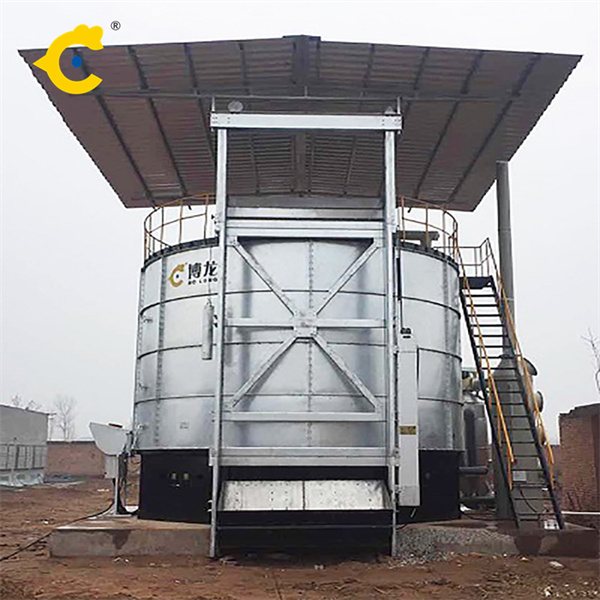
This is where a chicken manure compost machine stops being waste equipment and becomes part of the disease-control system. Four properties do the work.
Containment. The material is processed inside a sealed vessel, not an open heap. Flies, rodents, and wild birds cannot reach the mass inside an enclosed tank; the routes that carried pathogens back to the house are cut at the pile itself. The vessel's deodorizing function compounds this — a strong odor plume is what draws flies and scavengers in the first place, and reducing it shrinks the vector traffic around the unit.
Temperature on a schedule. An insulated tank with controlled airflow brings the material into the thermophilic range within the first days of a cycle and holds it there regardless of the weather outside — the vessel itself is the controlled environment, and it stands outdoors or under a shed roof without the biology caring. Where an open pile might reach killing temperatures for a few lucky weeks a year, the machine delivers them in every batch.
A short survival window. One complete cycle runs seven to ten days. In disease terms, that is how long the material stays infective: about a week between leaving the house and being safe to handle. An open pile, by contrast, grants pathogens a storage lease measured in seasons.
No standing stockpile. Because the tank runs continuously — today's litter in, last week's finished material out — the farm never builds a long-term heap at its boundary. The reservoir that kept refilling itself disappears for a structural reason: there is nowhere for it to exist.
The finished material earns a sentence of its own. Lab-tested output shows fecal coliforms not detected and ascaris eggs not detected — the two indicators most directly tied to this entire discussion — alongside organic-matter and nutrient levels suitable for fertilizer use. The waste stream ends as a clean product instead of a standing risk.
Equipment becomes biosecurity only when the routine uses it. Three habits make it real.
Move litter on a schedule, not on patience. Fixed removal intervals keep the house drier and ammonia lower, and they give the composter a steady input instead of crisis loads.
Place the unit outside the production zone. The rule of biosecure manure management is one-way flow: material crosses the boundary outward and never returns untreated. A composter sited outside the clean zone, loaded from the dirty side, completes that rule instead of violating it.
Spread only what has finished. Treated material is safe to return to cropland; untreated never is. Making that distinction a written rule rather than a habit is what turns the machine from equipment into policy.
Vaccination protects the bird. Disinfection protects the building. Thermophilic composting protects the material. A farm running all three is covered at every layer disease travels through.
Here is how to find out whether the hidden vector is live on your farm. Follow one day's litter from the house to wherever it ends up, and answer four questions along the way. Where does it go the day it leaves the house? Where does it sit, and for how long? Does it reach and hold thermophilic temperature — verified, not assumed? And what happens to it before it returns to your fields?
The stop where the answer turns vague is the farm's exposure. Send us the four answers together with your flock size, and we will map them against a chicken manure compost machine cycle: which stop each answer points to, what model fits your daily manure volume, and what a week-long turnaround would replace at the point where your trail currently goes dark.
1、What temperature does the chicken manure compost machine sustain?
The vessel holds the material around 55°C for several consecutive days within each 7-10 day cycle — the thermophilic range that eliminates fecal coliforms and renders ascarid eggs non-viable.
2、Is pathogen kill in the finished material verified?
Yes. Lab tests on finished output show fecal coliforms not detected and ascarid eggs not detected, with heavy metals well below safety limits and nutrient levels suitable for fertilizer use.
3、How does this differ from an open pile for disease control?
A pile stores contaminated material for months with full vector access; the sealed vessel processes it in about a week with none. In disease terms, the difference is how long pathogens remain infective anywhere on the farm.
4、What determines the right model?
The standard series covers 102-280 m³ of working volume. Daily manure volume and available site determine which model fits — the vessel stands outdoors or under a shed, so no building is required.












 Consultation


