Duck farming produces large volumes of wet, nitrogen-rich manure - often more than farmers expect. A single commercial duck house with 10,000 birds generates 1.5-2 tons of manure per day. Without a proper handling system, that manure becomes a daily problem: odor, flies, leachate, and growing environmental compliance pressure.
An organic waste fermentation tank offers a practical way to convert duck manure from a waste liability into a saleable organic fertilizer. This article explains why duck manure needs special handling, how the tank processes it, and what to look for when choosing equipment.
Duck manure differs from chicken and pig manure in several ways:
Higher moisture content. Duck manure typically has 70–80% moisture due to water-based drinking and bathing systems, making it harder to compost in open piles.
High nitrogen loss. Duck manure has a low C/N ratio. In open composting, excess nitrogen volatilizes as ammonia — creating odor and losing fertilizer value.
Pathogen load. Duck manure can carry salmonella, E. coli, and parasites that require sustained high-temperature treatment to neutralize.
These characteristics make open composting slow, smelly, and inconsistent. An organic waste fermentation tank addresses all three issues by moving the process into a sealed, controlled environment.
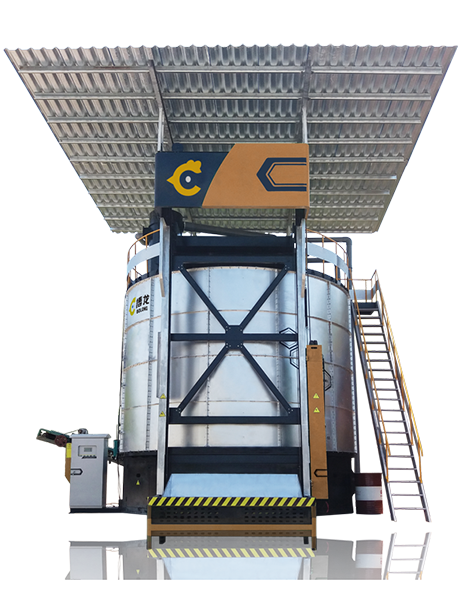
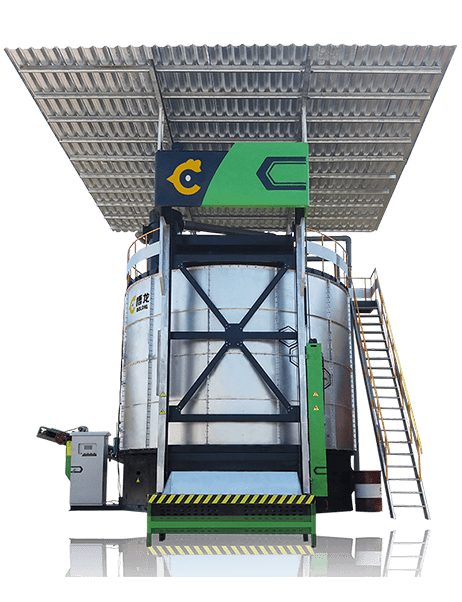
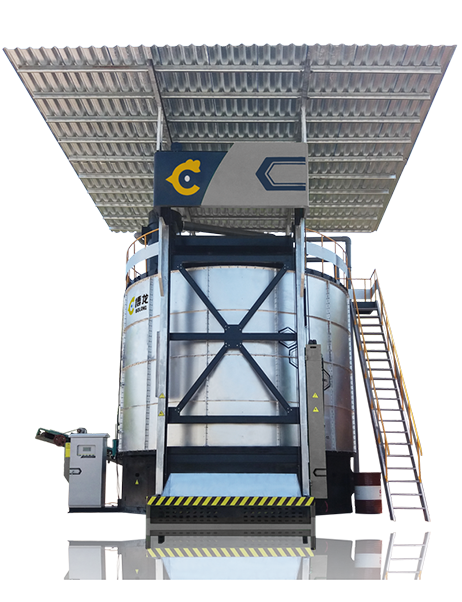
The organic waste fermentation tank is a sealed, insulated vessel with mechanical mixing, forced aeration, and temperature control. The process works as follows:
Step 1: Pretreatment. Because duck manure has high moisture content, it may need dewatering or mixing with dry bulking agents (straw, rice husks, sawdust) to bring moisture below 65% before loading.
Step 2: Loading and mixing. Manure is loaded into the organic waste fermentation tank and mixed by an internal auger system. Forced ventilation supplies oxygen to support aerobic microbial activity.
Step 3: High-temperature fermentation. Within 24–48 hours, internal temperatures climb to 55°C and hold there for 5–7 days. This kills pathogens, parasites, and weed seeds while stabilizing nitrogen into organic compounds that won't volatilize.
Step 4: Discharge. By day 7–10, the cycle is complete. The organic waste fermentation tank discharges a stable, dark brown, earthy-smelling organic fertilizer ready for bagging, sale, or field application.
The sealed design means no leachate escapes, no rainwater enters, and exhaust air passes through a deodorization system before release.
Four things matter most when processing duck manure specifically:
Moisture tolerance. Duck manure is wetter than chicken manure. The organic waste fermentation tank should either accept high-moisture input or integrate with a dewatering step. Ask the manufacturer about the maximum moisture content the tank can handle directly.
Mixing system. Duck manure tends to clump due to its high moisture and fibrous content. The organic waste fermentation tank needs a robust internal mixing system — not just a simple paddle — to break up clumps and ensure uniform fermentation.
Discharge quality. Ask for third-party test data on the finished fertilizer. Bolong's organic waste fermentation tank produces output with 52% organic matter, 11.9% total nutrients (N+P₂O₅+K₂O), fecal coliform negative, and heavy metals well below national standard limits.
Properly processed duck manure from an organic waste fermentation tank should have these characteristics:
Appearance: Dark brown, crumbly, uniform texture
Smell: Earthy, soil-like - no ammonia odor
Temperature stability: No reheating after discharge
Nutrient content: Total N+P₂O₅+K₂O above 5% (Bolong's output: 11.9%)
Pathogen indicators: Fecal coliform negative, ascaris eggs not detected
If any of these indicators are off, the organic waste fermentation tank cycle was incomplete - usually due to insufficient temperature hold, poor mixing, or excess moisture in the input.
Duck manure is not just a disposal problem - it is a nutrient-rich raw material waiting for the right process. An organic waste fermentation tank turns it into a stable, saleable organic fertilizer in 7–10 days, with one operator and no open piles.
Bolong organic waste fermentation tank handles duck, chicken, pig, and cattle manure, with various standard sizes from 102 m³ to 280 m³.
Contact Bolong to discuss an organic waste fermentation tank for your duck farm












 Consultation


