A single adult cow produces about 30 kg of manure every day. On a 1,000-head dairy farm, that works out to roughly 30 tons of fresh dung each day — and it keeps coming, seven days a week. Left to pile up, that volume does not stay neutral for long. It smells, it attracts flies, and rain carries it into ditches and groundwater. But the same 30 tons, put through the right process, is one of the most available and lowest-cost raw materials a farm can work with. The question is not whether cattle dung has value. The question is how to unlock it — and for a growing number of livestock operations, the answer is a customized fermentation tank.
Spreading raw cattle manure directly on crops sounds natural, but it skips a critical step. Fresh dung carries pathogens, weed seeds, and undecomposed fiber. Applied raw, it can burn young plants as ammonia and uric acid break down, wash into nearby waterways during heavy rain, and spread disease between animals and people working the land. Large livestock farms are increasingly treated as point sources of pollution, which means what leaves the farm — and what runs off it — is the farm's responsibility.
That is why the standard for treating livestock waste is not "dry it out" but "harmless treatment." Three things have to happen before manure can safely be called fertilizer. Pathogens such as fecal coliform and roundworm eggs have to be eliminated. The organic matter has to be stabilized so it will not heat up, smell, or re-ferment in storage or on the field. And heavy metals, where present in feed and bedding, have to stay below accepted limits. Only when all three conditions are met does cattle dung move from liability to asset.
Open piling and window composting can reach those standards — eventually. The catch is time and space. A pile of raw cow dung needs one to three months of turning, aeration, and weather cooperation before it is stable, and it loses nitrogen and mass along the way. On a farm producing 30 tons a day, a three-month stockpile is not a heap; it is an entire field. Rainy seasons turn it into a leaching problem, dry seasons into a dust and odor problem, and through it all the manure keeps arriving daily whether the pile is ready or not.
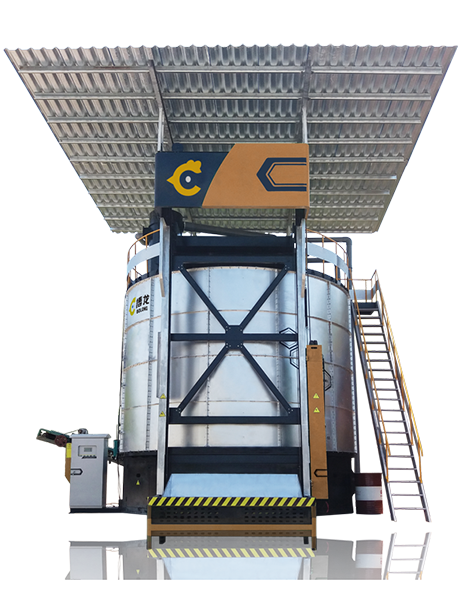
An enclosed fermentation tank compresses that timeline from months to days. The principle is the same biology that works in a compost pile — aerobic microorganisms breaking down organic matter — but inside a sealed vessel, conditions are controlled instead of left to the weather. Fresh manure is loaded into the tank, mixed and aerated continuously, and heated to sustained temperatures above 55°C. In 7 to 10 days, the process achieves what open piling takes months to reach: fecal coliforms eliminated, roundworm eggs inactivated, and the material stabilized into a uniform, low-odor product ready for storage or field application.
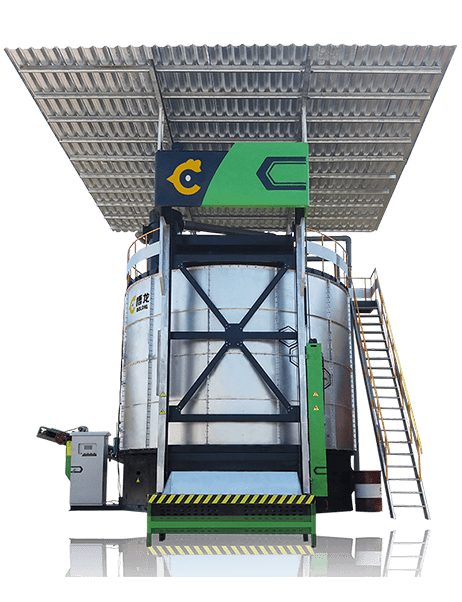
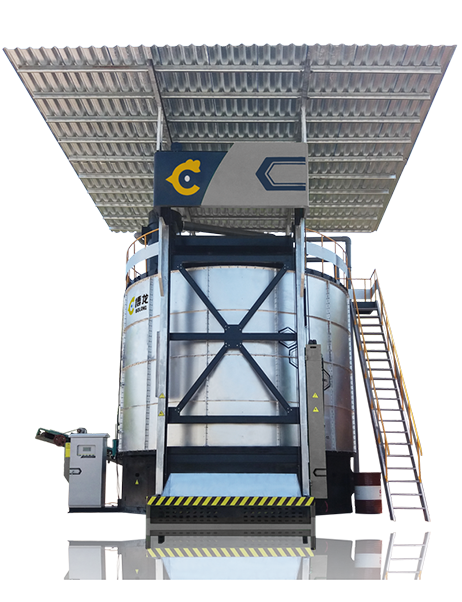
The equipment itself is built for continuous duty on a working farm. The material contact parts are stainless steel, chosen for corrosion resistance against manure acids and a long service life. The vertical, sealed structure keeps the footprint small compared to the area a windrow operation needs, and the integrated mixing, aeration, and exhaust systems mean the daily flow of manure moves through the tank without piling up around it. Beyond cattle dung, the same unit handles pig manure, chicken manure, sheep manure, mushroom residue, crop straw, and other organic waste — useful on farms that manage several waste streams at once.
Cattle operations differ more than the word "cattle" suggests. A dairy farm handles wetter, higher-volume manure than a beef fattening operation, and what suits one rarely suits the other unchanged. That is where a customized fermentation tank earns its name - not in the machine itself, but in how it is specified and equipped for your operation. Your daily manure volume and site footprint narrow down the model that matches your scale. Your humidity, temperature range, and corrosion exposure decide the material and insulation options. Your handling priorities decide which auxiliary equipment is included - deodorization, heat recovery, loading automation, and the like. The configuration is worked out from your numbers before anything is recommended, so the unit fits the operation from day one.
Day after day, the same volume arrives at the farm in the morning and leaves the tank about a week later as something entirely different: a uniform, stable material with moisture low enough to store or spread, and composition consistent enough to use predictably. Bolong-processed output has been independently tested at 52% organic matter and 11.9% combined N+P₂O₅+K₂O - above the 45% and 5.0% levels that organic fertilizer standards require - with fecal coliforms absent, roundworm eggs undetected, and heavy metals far below limits. Applied to cropland or pasture, the material works on the soil itself: improving structure, helping light soils hold moisture, and feeding the microbial life that keeps fields productive over years. The daily burden becomes a useful output - not because manure is valuable on its own, but because a week of controlled fermentation makes it so.
Picture the morning routine on your farm a year from now: the daily manure load goes into the tank, and about a week later it comes out as stable, tested fertilizer — no piles growing in the corner, no runoff after rain, no complaints from the neighbors. That is what a fermentation tank delivers, and it is not limited to the biggest operations. If that picture sounds like a better place to be than where your manure sits today, tell us about your farm — your herd, your current setup, the kind of output you would actually use. We will tell you honestly whether a fermentation tank fits, which model matches your scale, and what the finished fertilizer could be used for on your land.












 Consultation


