Pig farms produce more manure per animal than almost any other livestock operation. A single finishing pig generates 3-5 kg of manure per day. For a 1,000-head operation, that adds up to 3-5 tons daily - wet, smelly, and increasingly difficult to dispose of under tightening environmental rules.
An animal manure fermentation tank turns that daily burden into a stable, sellable organic fertilizer in 7-10 days. This article explains why pig manure needs different handling than other manure types, how the tank processes it, and what to avoid when setting up a pig manure treatment system.
Pig manure presents three challenges that make open composting particularly difficult:
High moisture content. Fresh pig manure typically contains 75-85% moisture - significantly wetter than chicken manure (60-70%). Open piles become anaerobic, producing foul odors instead of decomposing properly.
Antibiotic and heavy metal residues. Commercial pig operations commonly use feed additives that leave traces of copper, zinc, and antibiotics in manure. These residues can accumulate in soil if the manure is applied without proper treatment.
Strong odor. Pig manure produces higher concentrations of hydrogen sulfide and volatile fatty acids than poultry or cattle manure, making odor control a top priority for any treatment system.
An animal manure fermentation tank addresses all three issues through sealed, high-temperature processing.
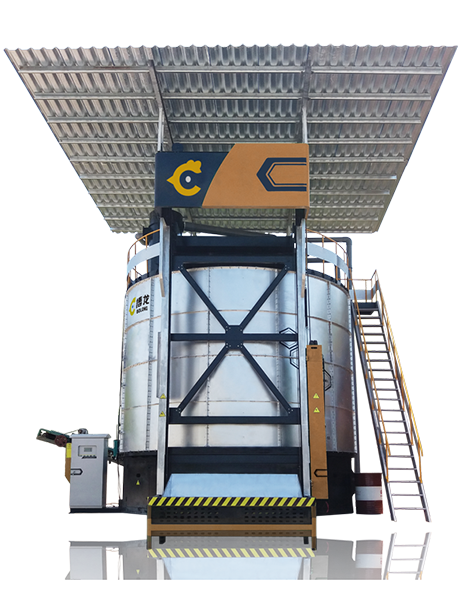
The animal manure fermentation tank is a sealed, insulated vessel with mechanical mixing, forced aeration, and temperature control. For pig manure, the process typically includes:
Pretreatment. Because pig manure is very wet, it usually needs mechanical dewatering or mixing with dry bulking agents (straw, rice husks, sawdust) to bring moisture below 65% before loading.
Fermentation. The pretreated manure is loaded into the tank, mixed by an internal auger, and aerated by forced ventilation. Within 24–48 hours, temperatures reach 55°C and hold for 5–7 days. This sustained high temperature kills pathogens, breaks down antibiotic residues, and stabilizes organic matter.
Discharge. By day 7–10, the animal manure fermentation tank discharges a dark brown, earthy-smelling organic fertilizer with consistent nutrient content.
The sealed design captures odor at the source. Exhaust air passes through a deodorization system before release, keeping odor within the tank area rather than spreading to surrounding neighborhoods.
Many pig farms attempt fermentation but get poor results. Here are the most common mistakes:
Loading manure that is too wet. Pig manure above 65% moisture turns anaerobic inside the tank. The animal manure fermentation tank cannot reach proper temperature, and the output smells like raw manure. Always dewater or add bulking agents first.
Skipping the high-temperature hold. Some operators discharge early to save time. Without the full 55°C hold, pathogens survive and the product is not safe for field application. A proper tank monitors temperature automatically and prevents early discharge.
Not cleaning between batches. Pig manure leaves residue on the tank walls and auger. Without cleaning between batches, the next batch ferments unevenly. Follow the manufacturer's cleaning schedule to keep every batch consistent.
The output of a properly operated tank should be verified by third-party testing. Key indicators include:
Organic matter above 30% (Bolong's output: 52%)
Total nutrients (N+P₂O₅+K₂O) above 5% (Bolong's output: 11.9%)
Fecal coliform negative
Ascaris eggs not detected
Heavy metals below national standard limits
Bolong animal manure fermentation tank meets all of these benchmarks, verified by third-party testing on every key parameter.
Pig manure is one of the most challenging waste streams in livestock farming - but it is also one of the most nutrient-rich. An animal manure fermentation tank solves the moisture, odor, and pathogen problems that make pig manure difficult, and produces a fertilizer that meets commercial standards.
Contact Bolong to discuss an animal manure fermentation tank for your pig farm












 Consultation


