Egg collection is still done by hand on many poultry farms. "Picking up eggs" may seem easy, but it hides big losses:
Bumps and knocks that break eggs
Grading is affected by dirty eggshells.
Longer egg retention times raise the risk of crushing.
In the industry, the rate of broken eggs when collecting them by hand is usually between 3% and 5%. But with the help of automatic egg collectors, this number can often be kept between 0.2% and 1%.
For a farm with 10,000 birds, this is not just a difference in numbers; it is a big difference in long-term profitability.
A lot of farms try to cut down on breakage by "handling eggs more carefully," but it doesn't always work. The reasons are:
Different operators and their conditions can make operations very different, which makes it hard to keep things the same over time.
Because manual collection can only happen so often, eggs build up in the nest boxes, which makes them more likely to break.
When you handle eggs by hand, they touch and move around a lot, which makes them more likely to break.
These problems are more about "process" than "whether the operator is diligent."
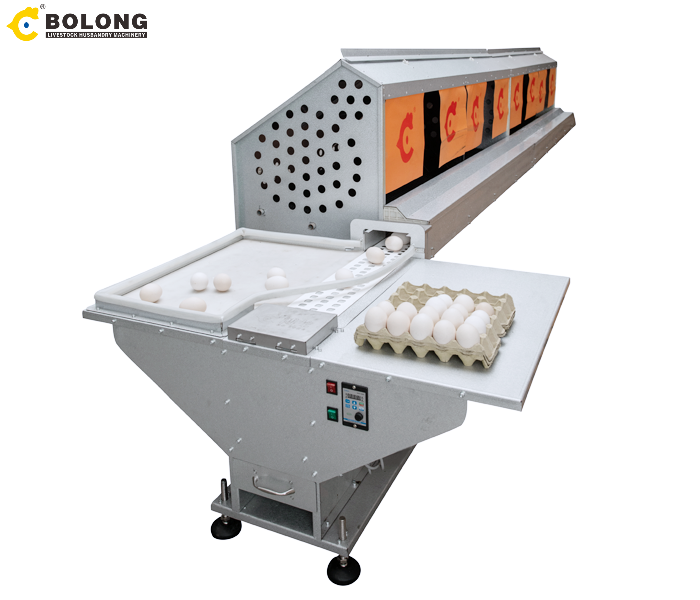
Here is a more "realistic" explanation based on how your equipment is actually built:
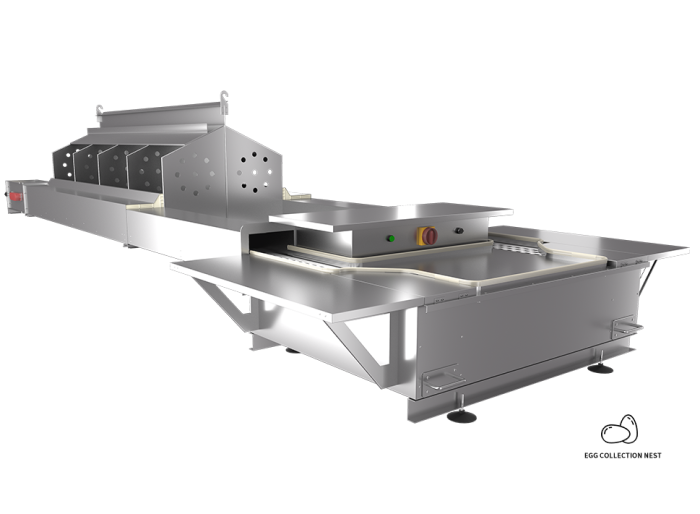
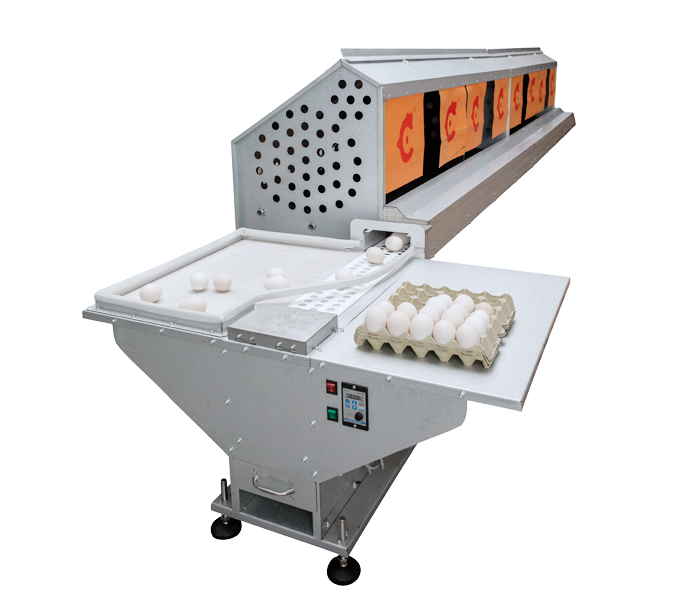
An automatic egg collector has a laying box, an egg chute, a conveyor system, and a control system that work together to collect eggs all the time.
The main idea is:
The bottom of the laying box has a soft padding structure and an incline of about 8°.
Eggs roll down the egg chute on their own after they are laid.
The eggs are moved to the collection platform by a conveyor belt inside the egg chute.
A central location is where collection and initial sorting take place.
This process cuts down on the number of steps that need to be done by hand, which is important for lowering the number of broken eggs.
The benefit of this automatic egg collector over traditional methods is not "speed," but "stability":
Fewer places to touch: The path is fixed and continuous from laying to collection, so there are fewer steps in between.
More even force distribution: The soft padding and sloped mesh floor make the rolling motion gentler, which stops stress from building up in one place on the eggs.
More controllable transport: The conveyor belt runs smoothly, so there are no bumps or shakes like there are when you do it by hand.
Better control of hygiene: Eggs go into the conveyor channel faster, which means they spend less time in contact with manure and helps lower the number of dirty eggs (about 0.2% to 1%).
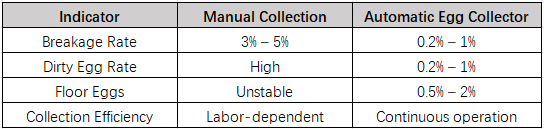
The end result is:
It not only cuts down on losses, but it also makes the production process more stable and predictable.
A lot of people think that the egg breakage rate can only be lowered by getting more experience with the process. However, in large-scale farming, the overall design of the egg collection process is what really matters.
An automatic egg collector is worth more than just replacing manual labor. It also gives you more control over every step of the process, from laying the eggs to collecting them, thanks to a stable conveying rhythm, a smart path design, and as little human involvement as possible. The rate at which eggs break will naturally go down as the process becomes more stable.
If you want to learn about automatic egg collector solutions for different scales or want to improve the way you collect eggs on your farm, click here to get in touch with us.












 Consultation


