In 2024, a typical environmental dispute arose in Chonburi Province, Thailand: local residents protested against wastewater discharge and foul odors from a pig farm, forcing the farm to make improvements within 30 days or face closure. However, this is not an isolated case.
Thailand's animal industry is going through a revolution. The trend toward industrialization is irreversible, says the Department of Animal Industry (DOA), with large pig farms with herds of 5,000 or more accounting for only about 0.11% of the total. The industry is expected to be dominated by large-scale farming by 2030, producing 20 million pigs annually. However, the traditional open-air storage and primitive fermentation pits can no longer meet the increasingly strict environmental requirements, which has exacerbated the NIMBY (Not In My Backyard) effects and frequent conflicts between farms and local communities.
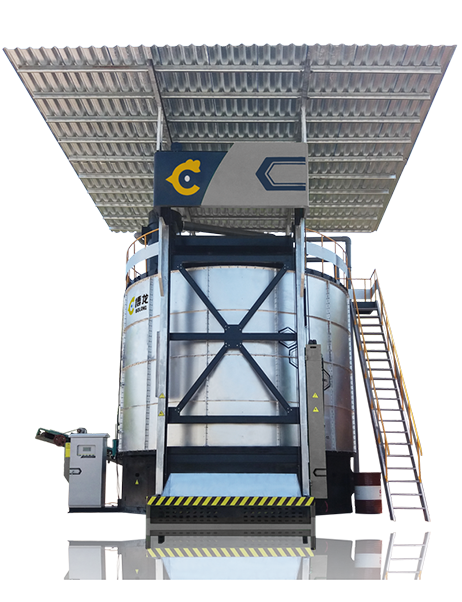
Therefore, the high temperature aerobic composting tank is becoming the focus of more and more large-scale farming projects.
Thailand is one of Southeast Asia’s leading livestock markets. The number of large-scale pig and poultry farms continued to increase. The increased stocking densities have also led to more pressure to treat manure and wastewater centrally.
For large-scale farms, the real challenge is often not just “manure treatment” itself, but the chain of problems it creates:
Diffusion of odor
Sewage treatment pressure
Fermentation unstable during rainy season
Mosquito and fly reproduction
Complaints from the local community
Higher costs of manual turning
The “not in my backyard” (NIMBY) effect is more and more pronounced, especially in farming projects near residential areas or industrial parks. Traditional open-air composting techniques (with high dispersion of odors and long fermentation cycles) cannot meet the needs of modern intensive farming.
The hot, humid, rainy climate of South East Asia further exacerbates the instability of traditional composting.
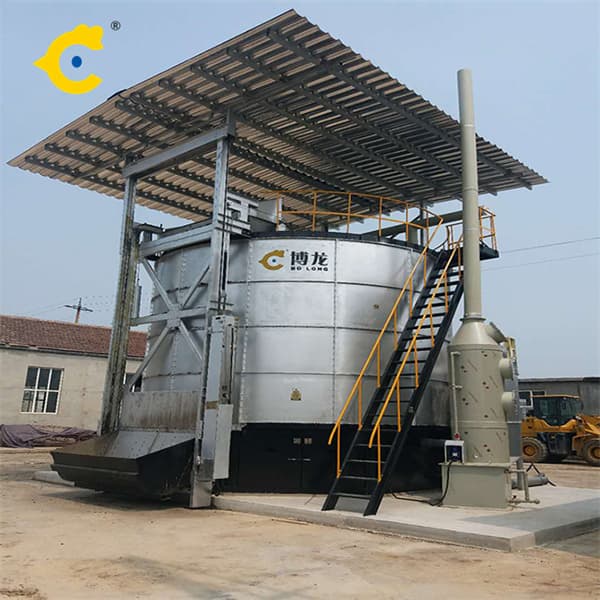
PLC-controlled fully automatic static sealed composting tanks have become the preferred solution for large-scale livestock farms due to regulatory pressure and community complaints. They have the following advantages:
Odor removal rate >95% : Spray tower + biofilter tower system solves odor leakage problems
24 hours continuous discharge: In accordance with the production rhythm of large-scale farms, no manual intervention is needed
Multi-unit Parallel Operation + Remote Monitoring: PLC control system allows remote data monitoring
For example, the model 11FFG-280 has a daily capacity of 20–28 m 3 , a fermentation cycle of 7 days and an area of about 100 m 2 . In the case of a pig farm with a stock of 5,000 head and manure moisture content of 55-65%, the full-volume manure treatment can be achieved with just two units.
Step 1: Preliminary Preparation
Thailand has abundant rice husk resources, making it an ideal conditioner. Fresh manure has a moisture content of 75–80%; adding rice husks adjusts this to 60–65%, with the carbon-to-nitrogen ratio controlled at 25–30:1.
Step 2: Process Control
Days 1–2: Heating Phase (25°C → 55°C)
Days 3–6: High-Temperature Phase (maintained at 55–65°C to eliminate pathogens)
Day 7: Cooling and Maturation Phase (65°C → 45°C)
The high temperature aerobic composting tank is equipped with an observation port at the top, allowing for continuous monitoring of the fermentation status inside the tank throughout the process.
Step 3: Value-Added Post-Processing
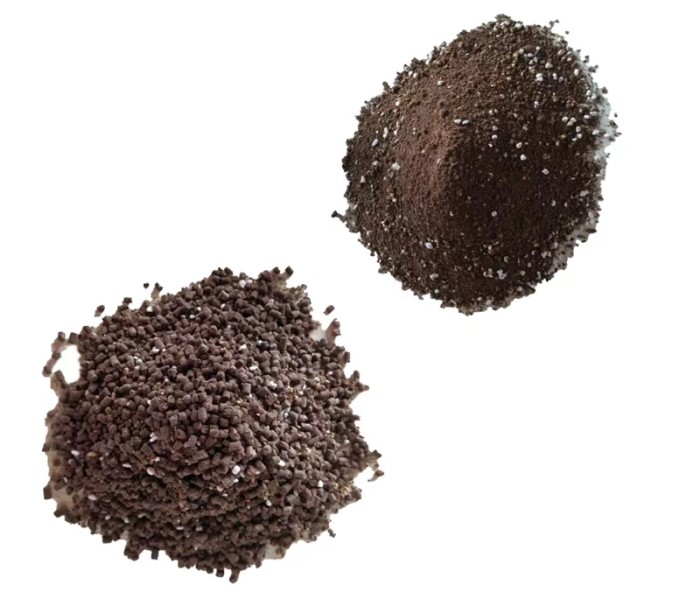
After screening, grinding, and pelletizing, the finished organic fertilizer can be put directly into use or sold, thereby generating secondary revenue and achieving a closed-loop system.
A modern pig farm with a capacity of 6,000 head faced severe environmental pressure. Odor issues had triggered multiple complaints from residents, and the local environmental protection department issued a rectification notice requiring a solution within a specified timeframe. The farm underwent an emergency renovation by installing a Model 280 fermentation tank.
Results After Renovation:
Environmental Indicators:Odor emissions reduced by 95%, with zero complaints from the surrounding community
Economic Benefits: Annual production of 12,000 tons of organic fertilizer, primarily sold to nearby tea plantations, orchards, and flower farms
Operational Highlights:
The equipment features fully automated control and mobile remote monitoring capabilities. The turning process, which previously required five workers operating in shifts, now requires only one person to conduct a daily inspection. The fermentation cycle has been shortened from the traditional three months to seven days, and production remains stable even during winter.
Feedback from the Manager:
"We used to dread inspections by the environmental protection bureau, but now we've become the village’s model facility for environmental protection. Our neighbors’ orchards come to us to buy fertilizer, and our relationships have improved."
As environmental regulations, operational efficiency, and the demand for resource recovery continue to rise, competition among large-scale pig and poultry farms is no longer limited to farm size alone.
Manure treatment capacity, automation levels, and long-term environmental compliance are becoming key factors influencing the sustainable development of livestock enterprises.
For modern livestock farms:
High temperature aerobic composting tanks are gradually evolving from “auxiliary equipment” into essential operational infrastructure.
If you are planning a manure treatment upgrade project for a pig or poultry farm and would like to learn about high temperature aerobic composting tank solutions suitable for large-scale operations, please click here to contact the Bolong team for further discussion.












 Consultation


