On many traditional farms, egg collection is a constant battle against breakage rates.
Industry data shows that in well-managed manual egg-collecting operations, breakage rates typically range from 2% to 5%; in standard farms, breakage rates generally reach 5% to 8%, and in poorly managed facilities, the rates are even higher. For a medium-sized farm producing 10,000 eggs per day, this means that hundreds of eggs may be discarded daily due to breakage, resulting in direct revenue loss.
To address this pain point, Bolong’s automatic egg collector utilizes technological innovation to keep the actual breakage rate at an ultra-low level of 0.2%–1%. This article will conduct an in-depth comparison between “manual collection” and “automatic egg collectors,” analyzing how technological upgrades can facilitate a shift from “passively accepting losses” to “actively controlling quality.”
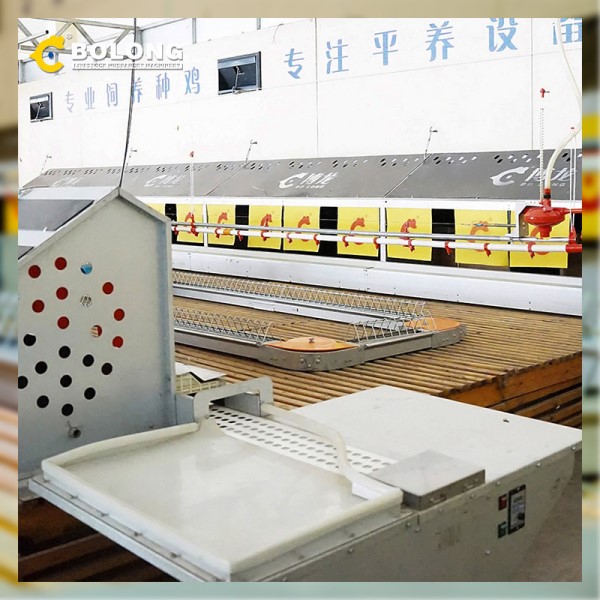
Although eggshells are hard, they are extremely susceptible to cracking when force is applied to the sides because their resistance to pressure is concentrated primarily at the top and bottom. During manual collection, eggs are transferred multiple times: from the bottom of the cage into the collector’s hands, from the hands into egg trays and then into transport vehicles. Each transfer poses a potential risk.
Statistics show that the overall breakage rate of eggs collected manually is gradually increasing. In the afternoon, workers tend to become fatigued, which leads to decreased concentration and a significant increase in egg breakage rates.
Direct human contact with eggshells can introduce bacteria into the eggs, affecting not only food safety, but also causing the eggs to fail inspections required for export or high-end markets. Manual operations also make it difficult to ensure consistent cleanliness for every egg, resulting in inconsistent product grades.
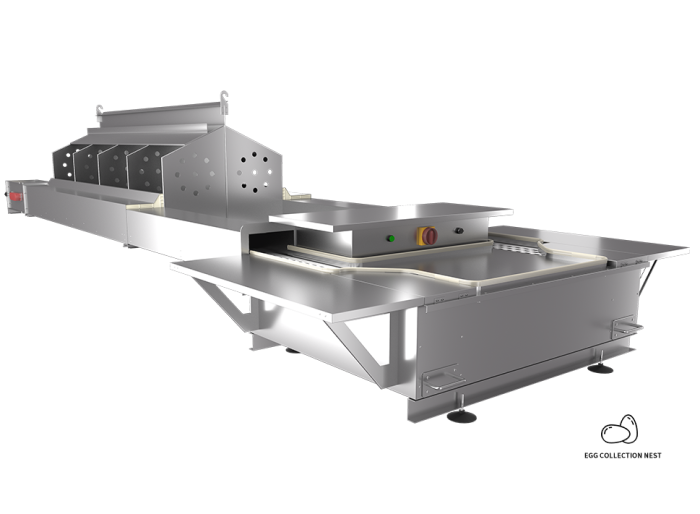
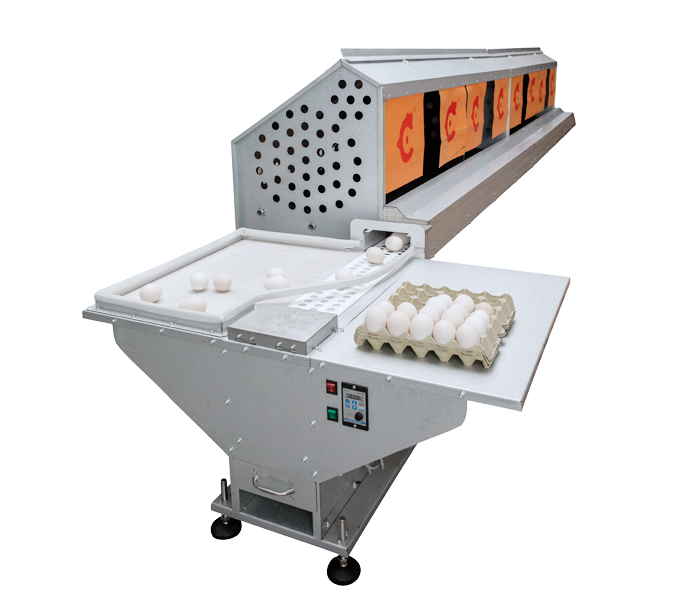
The egg tray is lined with a special mesh grass mat. Its special mesh structure provides elastic support. The eggs drop from the bottom of the cage and hit the mat so they don't hit hard. The non-slip and breathable design also prevents the eggs from rolling and colliding with each other, providing an extra layer of protection against initial damage.
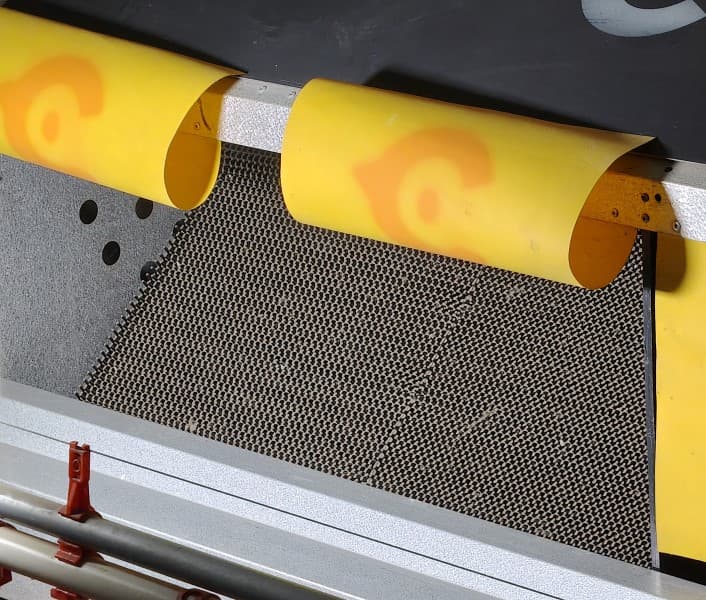
The motor driven operation keeps the speed constant which prevents the accumulation of eggs and crushing that can happen with variable speed.
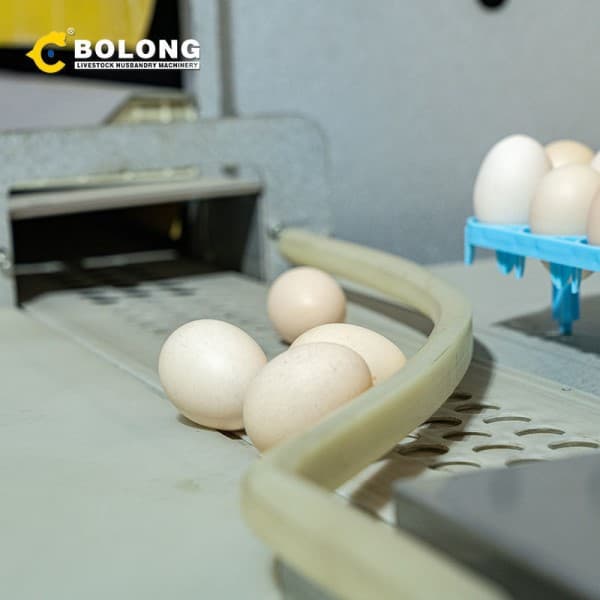
And the automatic egg collector has a square hole egg belt, each hole exactly 'locking' a single egg in place. Compared to open conveyor belts, the square-hole design effectively prevents the eggs from shifting and crushing each other during the transport.
3. Reduced manual intervention
The automatic egg collection system reduces the need for manual handling thanks to its stable conveyor belt operation. Eggs are transferred directly from the laying boxes into the conveyor system, minimising the risk of collisions during intermediate handling.
Q1: How long does it take to install an automatic egg collector?
A: Installation typically takes 1–2 days and does not disrupt normal production.
Q2: How long does the egg collection belt last?
A: It’s made from food-grade, wear resistant plastic with a strong metal frame, and can last you 1-2 years under normal use. If wear occurs , individual sections of the belt can be replaced without replacing the entire unit , keeping maintenance costs low .
Q3: Will the automatic egg collector damage the eggs when the power is cut off?
A: No, the equipment is equipped with a power failure deceleration device, which makes the conveyor belt decelerate slowly. And the whole thing is modular, so eggs can be safely removed without getting stuck in the system in case of a power failure.
Q4: How do I clean the automatic egg collector to maintain hygiene?
Thanks to its modular design and self-cleaning return section, daily maintenance requires only a simple rinse. For deep cleaning, components such as the straw mats and egg belts can be easily removed, and cleaning schedules can be adjusted according to actual farming conditions.
The choice to use the Bolong automatic egg collector is not just an equipment upgrade, it is a change in management philosophy. In the highly competitive poultry egg market, a reduction in the breakage rate directly increases the net profit. Bolong Automatic Egg Collector has helped many farms transform from "passively accepting losses" to "actively controlling quality" with an ultra-low breakage rate of only 0.2-1%.
To learn more about our products, contact Bolong today.












 Consultation


