South America's livestock belt runs through some of the wettest farming regions on the planet. In the Brazilian states of Paraná and Santa Catarina - heart of the country's poultry industry - annual rainfall regularly exceeds 1,500 millimeters, much of it concentrated in a wet season that can stretch for six straight months. Humidity stays high, drying windows shrink, and the ground itself stays saturated. For farms that manage thousands of tons of manure a year, the arithmetic is unforgiving: the weather decides when processing happens, not the farm. An enclosed aerobic fermentation tank is built to change that - to keep manure moving through the system on schedule, whatever the sky does outside.
Aerobic composting only works within a narrow range of moisture levels. The microbes that convert manure into stable organic fertiliser require oxygen to do their job, and they can only obtain it when the moisture content of the pile remains at around 55 to 65 percent. Rain disrupts this balance from both directions. It soaks the pile from above, pushing the moisture content towards 75 per cent or higher. At this point, water fills the pore spaces between particles and oxygen can no longer reach the centre. The aerobic bacteria that generate heat then begin to die off.
The consequences become apparent quickly. The pile temperature — the key indicator for every composter — drops from the 55°C zone that kills pathogens towards ambient temperature. Fermentation stalls. The material that was halfway to becoming finished fertiliser begins to turn anaerobic, producing hydrogen sulfide and ammonia. This is the smell that neighbours complain about, and the reason why municipalities start sending out inspection letters. Even worse, a waterlogged pile loses its structure, sagging and slumping under its own weight. Turning equipment cannot get a blade through the saturated mass. The entire batch sits idle until the ground dries, which in a six-month rainy season may not happen until the next dry spell. An enclosed aerobic fermentation tank does not have any of these issues because the material inside never comes into contact with rainwater.
The true cost of rain is rarely visible in a single day; it builds up over the course of a season. A windrow system that completes a batch in seven to ten days under clear skies can take 30 or even 60 days during heavy rain. Processing capacity drops by half or more at the very time when manure continues to accumulate. Stockpiles grow. Instead of running a production line, the farm ends up managing a storage crisis.
Then there is the output side to consider. Manure that has been rained on, re-wetted and partially fermented produces an inconsistent product with high moisture content, uneven stability and uncertain pathogen status. This material has a lower fertilising value and, in stricter regulatory environments, it can be difficult to apply to land at all. Several South American countries are tightening these rules: Argentina's SENASA Resolution 214/2025 raised the registration bar for organic fertilisers, and enforcement around waste handling in Chile and Bolivia has become visibly stricter. A process that only works in dry weather is becoming increasingly problematic, and replacing it with an enclosed aerobic fermentation tank would remove the weather from the cost equation entirely.
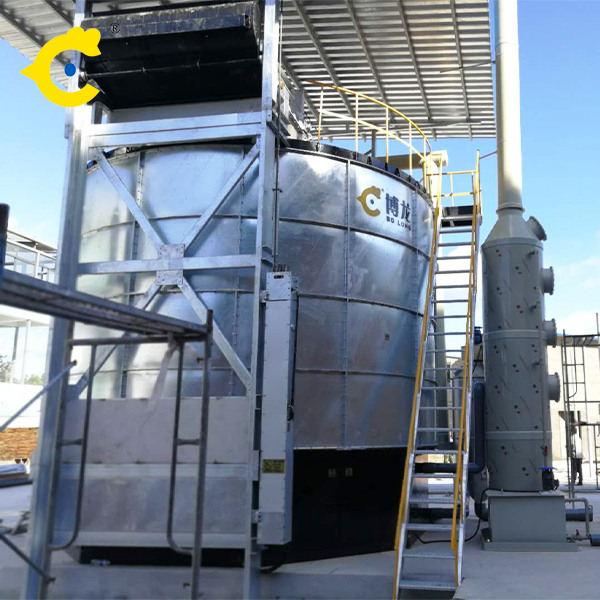
The answer does not lie in a better tarp or a larger turning machine. The solution is to remove the impact of the weather entirely. An enclosed aerobic fermentation tank seals the process inside a steel vessel. Manure is loaded at a controlled moisture ratio and, from that point on, it cannot be reached by rain, saturated by humidity or cooled by outside temperature. Oxygen is supplied by forced ventilation rather than wind and turning, providing a consistent supply to the microbial population regardless of external conditions.
Inside the sealed vessel, conditions are kept at the optimal level for fermentation. The biological heat generated by the microbes drives the core temperature to a stable 55°C, which is maintained throughout the full cycle of 7–10 days, providing sufficient time to break down pathogens and stabilise the material. The difference between this system and an open windrow during the wet season is stark: one system has to fight the weather, while the other simply doesn't. For farms running continuous operations — with daily manure intake and output — that reliability is paramount.
It is widely assumed that enclosed systems must be expensive to run, and that sealing and ventilating a process must consume large amounts of electricity. In practice, however, the opposite is true, and this is where the energy-saving design of an enclosed aerobic fermentation tank comes into its own. The microbes themselves produce the heat that drives the process, not electric heaters. The tank's insulated walls trap this biological heat, enabling the system to maintain a temperature of 55°C with minimal external energy input. A heat recovery unit takes efficiency a step further by capturing the heat from outgoing gas and using it to pre-warm fresh air entering the system instead of letting warm exhaust air escape. Consequently, every ventilation cycle starts closer to fermentation temperature and remains there while using less energy.
Compare this with a windrow in the rain, where every time the pile is cooled by a storm, the biological process has to restart from near ambient temperature, resulting in a significant amount of wasted energy. The electricity consumed inside an enclosed aerobic fermentation tank is mostly used for ventilation and mixing. Modern control systems operate these functions intermittently, only when oxygen or agitation is needed. The result is a processing method with a consistently lower energy cost per tonne of manure than repeatedly drying out, reheating and turning rain-soaked windrows throughout the season. Here, energy efficiency is not just a marketing claim; it is the direct consequence of keeping a biological process within its operating range rather than letting the climate knock it out of it.
Every batch produced by an enclosed aerobic fermentation tank running at 55°C for a full cycle is identical. This consistency has real commercial value. Bolong enclosed fermentation systems produce finished material containing around 52 percent organic matter, 11.9 percent total nutrients (N+P₂O₅+K₂O), and less than 25 percent moisture — figures that a rain-disturbed windrow simply cannot deliver consistently. Fecal coliforms are not detected and parasite eggs are eliminated, which is important when buyers or regulators request proof. A farm that can demonstrate consistent, documented output quality can maintain its fertiliser sales, spreading or compliance activities without interruption throughout the year.
This does not mean that open-air composting is useless. In dry regions with short wet seasons and high evaporation rates, windrows can still be effective. In South America's tropical and subtropical zones, the problem is specifically the rain: the long wet season renders a workable method unreliable. Every farm in these regions needs to ask itself not whether composting works in theory, but whether it works during the six months of the year when it matters most.
Think about your own wet season for a moment. How many weeks of the year does your farm effectively lose to rain, during which time windrows sit soaked, the turning machine remains parked up and fresh manure continues to pile up? Now picture the same area with an enclosed tank that runs steadily at 55°C and converts daily manure into dry, stable fertiliser instead of a soggy, smelly liability. This illustrates the difference between a processing line that is dependent on the weather and one that simply runs.
If this sounds like your operation, just tell us your daily manure volume – how much do you handle on a typical day? We will use this figure to match you with the enclosed aerobic fermentation tank model that is sized for your operation. We will also provide you with information on the cost of running the tank and what your finished fertiliser will look like. From there, the decision is yours — based on numbers, not guesswork.












 Consultation


