On a humid July morning, the wind shifts and the first complaint call arrives at the front desk of a 30,000-head pig farm. The caller lives two kilometers downwind. The complaint is the same one almost every summer: a smell like rotten eggs drifting into a kitchen window. The farm has tried covers, sprays, and aerators, but the smell still comes back whenever the weather turns warm.
That smell is hydrogen sulfide, and it forms almost nowhere else in a livestock operation as consistently as it does inside an anaerobic lagoon. A wet summer pushes lagoon pH down into the 5.5 to 6.0 range, the slurry settles into a thick bottom layer, and sulfate-reducing bacteria go to work on the sulfur amino acids in pig manure. The result is a steady release of H₂S that travels further than anyone expects. Even at concentrations as low as 0.5 parts per million, the human nose picks it up.
Hydrogen sulfide production follows a well-known rule. It needs three things to occur at scale: an oxygen-free environment, a low pH, and a supply of sulfur-bearing organic material. The first two arrive automatically inside an anaerobic lagoon; the third is built into every batch of pig manure.
Pig manure carries methionine and cysteine from undigested feed. When those amino acids break down under anaerobic conditions, sulfate-reducing bacteria convert the sulfur into sulfide ions. At low pH, those ions combine with hydrogen to escape as H₂S gas. The hotter the weather, the faster the release. The deeper the sludge layer, the more surface area is generating gas.
Covering the lagoon with a floating membrane only traps the gas; it does not stop the reaction. Spraying masking agents in the neighborhood covers up the symptom with fragrance, but the chemistry inside the lagoon keeps producing. What changes the chemistry is removing the anaerobic conditions at the source.
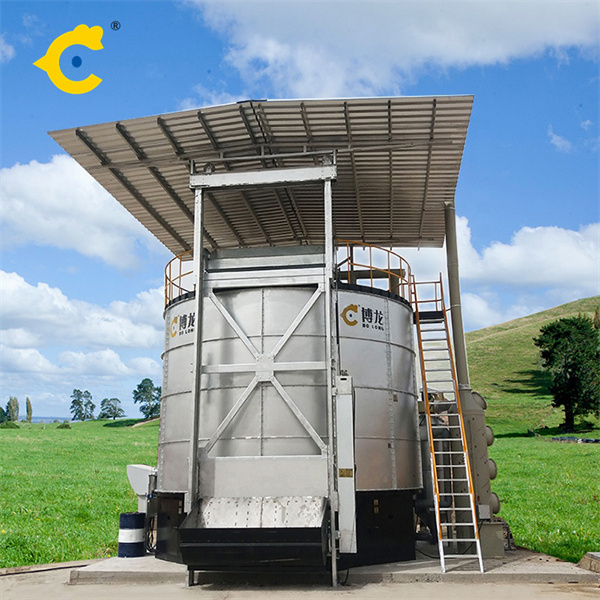
The shift that ends hydrogen sulfide at a pig farm is not a piece of equipment added to the existing lagoon. It is a process change that replaces the anaerobic lagoon with a sealed aerobic fermentation tank — a vessel in which forced aeration keeps the environment oxygen-rich for the high-temperature microbes that break down the manure. Solid manure is separated and loaded into the enclosed vessel, where controlled temperature sustains that aerobic process through the cycle. Liquid effluent moves to an oxidation pond with active aeration rather than passive settling.
A customized fermentation tank is sized and configured around the specific manure characteristics, water content, and climate of the farm that orders it, which is why a one-tank-fits-all approach does not work for pig operations. For a farm in a hot, humid climate the focus is on aeration capacity and moisture control. For a farm in a cold climate the focus is on insulation and the ability to maintain biological heat through winter. For a farm with very high water content in the manure, the configuration includes a solid-liquid separation stage before the tank.
One Vietnamese farm operating a 30,000-head facility worked through a similar configuration. The site had been struggling with manure accumulation, wastewater that failed discharge standards, and summer odor that disrupted nearby villages. After switching to a Bolong customized fermentation tank built around its specific waste profile, the operation reported an odor reduction of more than 80 percent and a 7-day composting cycle that turned pig manure into a stable organic fertilizer.
While the reduction in hydrogen sulfide is the headline result, the supporting numbers are equally important. The sealed fermentation tank holds the manure at temperatures between 50 and 60 °C throughout the cycle. This range inactivates pathogens, parasite eggs and odour-causing microbes. The water content of the finished product drops to 20–25%, which is below the level at which any further biological activity can restart.
The manure exiting the tank does not require further management. Rather, it is a finished organic fertiliser containing over 45 percent organic matter, with total nutrients (N + P₂O₅ + K₂O) above 5 percent, and with verified negative results for faecal coliforms and parasite eggs. The farm is no longer carrying a long-term liability, but rather a product that can be sold, given to neighbours, or returned to the field.
Most equipment sold under the heading of 'odour control' treats hydrogen sulfide after it has already left the lagoon. Biofilters pass the gas through a moist organic bed, where microbes oxidise some of the sulfide. Chemical scrubbers absorb some of it using reactive solutions. Masking agents add fragrance to overwhelm the smell.
All three approaches share a structural problem. The lagoon continues to produce hydrogen sulfide as soon as the cover is opened, as soon as the spray wears off and as soon as the biofilter media becomes saturated. Operating costs compound year on year. Spent media and scrubber solution become a new waste stream. The lagoon itself remains unchanged.
A customized fermentation tank moves the chemical processes out of the lagoon and into a sealed vessel. No surface area is exposed to the wind. There is no anaerobic zone producing H₂S. Any off-gassing from the tank passes through a dedicated treatment module before reaching the atmosphere. While the lagoon uses anaerobic processes, the sealed aerobic fermentation tank uses aerobic processes from the moment manure enters the vessel. The odour that prompted complaints is no longer being produced at source, meaning the farm no longer needs to pay to cover it up.
A customized fermentation tank does not just remove the smell; it lets the farm reclaim the ground the lagoon used to occupy. A farm that commits to the system still has to deal with the lagoon that is already there. The right sequence is to commission the new system, confirm steady operation for at least one full cycle, and only then begin the lagoon decommissioning work.
Sludge is pumped out and either fed back into the new fermentation tank as part of the normal loading, or hauled to a permitted off-site facility. The empty lagoon basin is cleaned, tested for any residual contamination, and either repurposed for rainwater storage, backfilled to grade, or returned to crop production depending on local regulation.
A hydrogen sulfide complaint that started two kilometers away usually stops being a complaint once the source is gone. The way to make it stop is to take the chemistry out of the open and put it inside a vessel that is sized, insulated, and aerated for the specific farm.
Send us your herd size, the surface area and depth of your existing lagoon, the current sludge removal cycle, and the climate zone you operate in. The engineering team will respond with a tank size, an aeration plan, and a decommissioning sequence that fits the site you already have.
Q1. Is hydrogen sulfide the only gas a pig lagoon releases?
No. Anaerobic lagoons also release volatile fatty acids, ammonia, mercaptans, and indole. Hydrogen sulfide is the one most often mistaken for the whole smell because the human nose picks it up at the lowest concentration.
Q2. Can a customized fermentation tank handle manure with very high water content?
Yes, but the configuration usually includes a solid-liquid separation stage ahead of the tank. The tank itself is designed for stackable solids at around 60 to 65 percent moisture, with the separated liquid routed to a separate aerobic treatment step.
Q3. How long does it take to see the odor drop after installation?
Most farms report a noticeable drop within the first full cycle, which is seven to ten days for the first batch, and the drop continues to deepen as the lagoon level falls.
Q4. Does a customized fermentation tank work in cold climates?
Yes. The vessel is insulated and uses biological heat from the active composting process to maintain internal temperature. For very cold regions the configuration includes extra insulation and a heated air-inlet module.












 Consultation


