Every guide on composting gives you the same number: four to six months. What those guides rarely mention is that the number assumes nobody touches the pile - no turning, no temperature control, no air pushed through the mass. Six months is what chicken manure takes when the only thing you contribute is patience.
Three timelines exist for the same material. Left alone in a windrow: four to six months. Turned twice a week: roughly 30 to 45 days. Held at 55 degrees C in a vessel that feeds air through the mass continuously: seven to ten days — which is what a chicken manure compost machine is built to do.
The rest of this article covers what sets the clock, what each route costs on the ground, and how to tell when material is genuinely finished rather than merely old.
The rate at which chicken manure breaks down is determined by two factors: how hot the mass gets and whether oxygen reaches the middle of it. Additives and inoculants are not as important as these two factors.
Temperature comes first. The microbes responsible for the breakdown process work best between 50 and 65 degrees Celsius — 55 degrees Celsius is usually the target — and become virtually inactive below about 20 degrees Celsius, which is why composting stalls completely in winter. In a passive pile, only the core reaches the working range, while the outer third stays cool and is largely inactive.
Moisture is the next factor. Below 40 per cent, activity stalls. Above 65 per cent, water fills the pore spaces, air stops moving and the mass slides towards anaerobic conditions. The optimal moisture content is roughly 50 to 60 percent — similar to the wetness of a wrung-out sponge.
The carbon source and particle size are related to the loading rather than the timing. Nitrogen-rich chicken manure usually requires the addition of materials such as straw, sawdust, rice husk or dry litter in order to bring the C:N ratio into the 25:1 to 30:1 range. This process is explained step by step in the walkthrough on how to properly ferment chicken manure.
Aerobic decomposition also continuously consumes oxygen. If you starve the process of oxygen, it slides into anaerobic breakdown, which is cooler, slower and far smellier.
All of the above holds true regardless of the equipment used. The difference between four months and seven days simply reflects how consistently those conditions are maintained, and a chicken manure compost machine is designed precisely for this purpose.
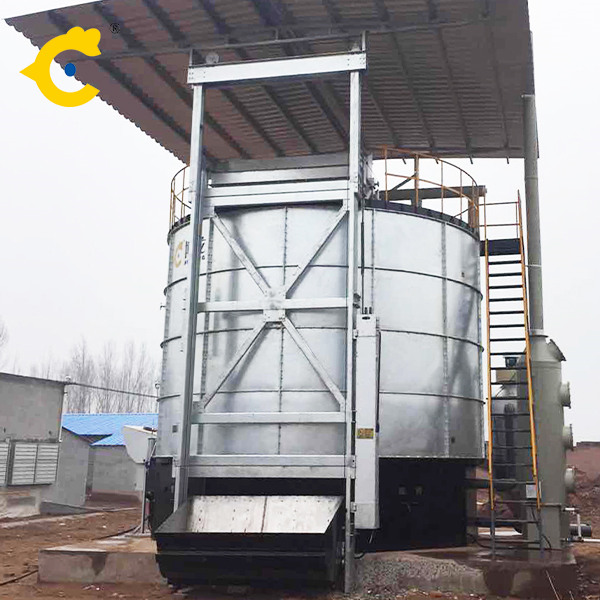
Hold the same chicken manure at 55 degrees C with air pushed through it continuously and the cycle drops to seven to ten days.
An enclosed aerobic fermentation tank does not work by adding anything exotic to the pile. It simply refuses to let those two controlling conditions drift. Insulation, plus the heat the mass generates itself, keeps the temperature in range. A blower delivers air through the full depth of the material rather than the top 30 centimetres. The shell keeps rain out and holds moisture close to where it was set at loading.
The equipment sits outdoors or under a simple shelter. It does not require a building, which surprises people who assume fermentation equipment is an indoor process — the vessel itself provides the environment it needs.
The time compresses because the whole mass spends the entire cycle inside its working range, rather than a few centimetres at the core reaching that range briefly. That continuity is the whole reason a chicken manure compost machine finishes in days: nothing in the mass is ever waiting for conditions to come back. In Bolong's 11FFG series the working volume runs from 102 to 280 cubic metres, with each model matched to a daily intake figure. What comes out tests at around 22 percent moisture, 52 percent organic matter, and 11.9 percent combined nitrogen, phosphate and potash — dry enough to handle, spread or bag without any further drying.
Two things worth being precise about. The process consumes oxygen constantly, which is why forced aeration is not an optional extra. And it does generate ammonia: nitrogen in the manure converts to NH3, and at 55 degrees C a good deal of it volatilises. A sealed tank does not prevent that — what changes is where it happens. The release point moves from an open yard into a vessel whose exhaust passes through a deodorising stage that removes over 95 percent of the ammonia and odorous compounds in that exhaust stream before it is discharged.
Seasonal behaviour deserves its own treatment, and it is worth reading separately if you farm somewhere with a genuine winter.
Compost is finished when the mass stops heating on its own. Temperature, not the calendar, is the only signal worth trusting.
Open the pile and check four things. The material should have cooled to within a few degrees of ambient and stayed there after being turned, rather than rebounding — a pile that reheats still has food left in it. Moisture should have fallen below roughly 30 percent, so the material crumbles instead of smearing. It should no longer smell of ammonia, and there should be no recognisable manure structure left — no visible litter, no intact material from the house. If the compost is going to a buyer, run a germination test: sow a fast seed such as radish or cress in a diluted extract and see whether it comes up. Immature compost suppresses it.
A short cycle makes these checks more important, not less. A chicken manure compost machine compresses the timeline; it does not remove the need to confirm the material has actually stabilised.
Appearance alone is a poor guide. Material that looks dark and crumbly can still be phytotoxic, and plenty of "finished" compost has quietly burned a crop because nobody checked anything beyond how it looked.
The problem with a six-month cycle is not the waiting. It is that you have to store every kilogram the farm produces during those six months, and that stock becomes a liability from the day it starts.
Work it out from your own figures rather than a rule of thumb — whatever tonnage you clear in a week, multiplied by twenty-six. That is roughly what you are holding at steady state on a six-month cycle, sitting in the weather, generating runoff, and giving the nearest neighbours six months of reasons to complain. Bring the processing time under two weeks and the standing stock collapses to something that fits in one tank plus one storage bay — which is the reason most farms look at a chicken manure compost machine in the first place: not the speed itself, but the ground it gives back.
It shortens the complaint window as well. Odour complaints rarely trace back to a single event; they come from a source that has been present every day for months. And it changes whether manure is something you move reactively — because the heap is in the way again — or on a schedule you set yourself.
For farms running out of space rather than out of patience, this is usually the arithmetic that ends the argument about composting time.
Any of the three timelines above will get you finished material. Only one of them fits on a pad you already own, and that is what a chicken manure compost machine is actually buying you — not just days off the clock, but the space those days were occupying.
Send us what you clear in a week — tonnes, truck loads, either works — and we will come back with the tank model that processes it in a single seven-day cycle, the footprint that model needs, and the figures your first batch should test at. One working day to get that answer, and nothing is required from you beyond the number.
1、How long does chicken manure take to compost in an open pile?
Four to six months in most conditions, and closer to eight across a cold or wet season. A passive windrow loses heat from its surface as fast as the core produces it, and oxygen only penetrates about 30-40 cm, so most of the mass never reaches working temperature.
2、Can the composting time be shortened?
Yes, by controlling temperature, moisture and oxygen supply. Turning twice a week brings it to roughly 30-45 days. Holding the mass at 55 degrees C with continuous forced air inside a chicken manure compost machine brings it to 7-10 days.
3、How long does a chicken manure compost machine take compared with windrow composting?
A machine that controls both variables works in days rather than months — 7 to 10 days per cycle for an enclosed aerobic tank, against four to six months for a passive windrow. The difference comes from keeping the entire mass inside its working range for the whole cycle instead of briefly at the core.
4、How do I know when chicken manure compost is finished?
Check four things: the pile no longer reheats after turning, moisture is below about 30 percent, there is no ammonia smell and no recognisable manure structure, and a seed germination test comes up normally. Time elapsed is not a reliable indicator.
5、Does faster composting change the quality of the finished product?
Run properly, it holds up. Material from a 7-10 day enclosed cycle has been measured at 22 percent moisture, 52 percent organic matter and 11.9 percent combined N, P2O5 and K2O, with moisture low enough to spread or bag directly. Speed alone does not guarantee this — temperature control and aeration do.












 Consultation


