Manure composting has been done the same basic way for a long time: pile it up, turn it occasionally, wait a couple of months, hope the weather cooperates. Many farms are still running this exact process today — not because it's the best option, but because it's the one they've always used. Meanwhile, the technology available for turning manure into usable fertilizer has moved forward significantly, and a growing number of farms are switching to a poultry manure composting machine instead of sticking with methods that haven't changed in decades.
It helps to see composting as a technology that's gone through real generations, not just minor tweaks:
First generation — open piles. Manure is simply stacked and left to decompose naturally. Slow, inconsistent, and completely dependent on weather.
Second generation — windrow composting. Long rows of manure are periodically turned with equipment to add oxygen. Faster than open piles, but still weather-dependent, land-intensive, and labor-heavy.
Third generation — static aerated piles and rotary drums. Mechanical aeration or rotating drums speed up decomposition and reduce manual turning, but many designs are still partially or fully exposed to outside conditions.
Current generation — enclosed poultry manure composting machines. Fully sealed systems that control oxygen, temperature, and moisture internally, independent of outdoor weather, land availability, or manual labor for turning.
Each generation solved part of the problem. The poultry manure composting machine is the first design that addresses nearly all of them at once — speed, land use, weather dependency, labor, and odor — inside a single enclosed structure.
The real difference isn't just "newer equipment." It's control. Open and windrow composting rely on nature to provide the right oxygen levels, temperature, and moisture — which means results vary by season, climate, and how consistently someone turns the pile. A modern composting tank removes that variability by managing those conditions mechanically and continuously, regardless of what's happening outside.
That shift — from relying on natural conditions to actively controlling them — is what separates older composting methods from current-generation equipment.
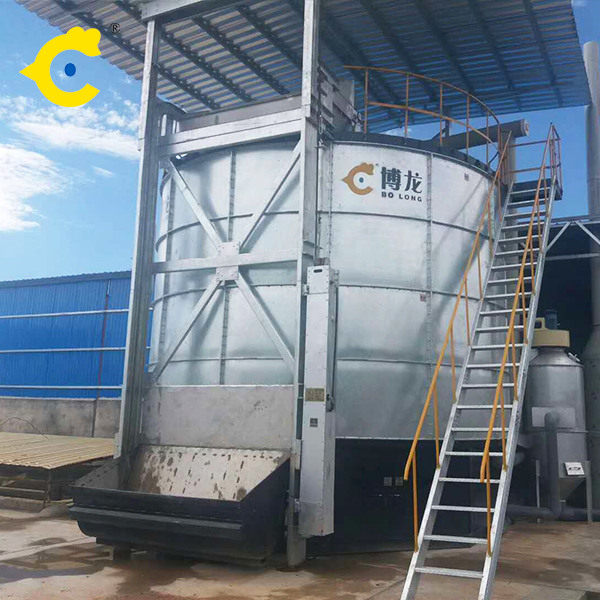
Bolong Poultry Manure Composting Machine reflects what current-generation composting technology actually looks like in practice:
Enclosed, vertical tank structure — manure is hydraulically lifted and loaded into a sealed vessel, removing dependence on outdoor weather or large land footprints entirely.
Automated internal mixing — five mixing blades continuously turn the material, replacing manual or tractor-based windrow turning.
Heat recovery system — a built-in heat exchanger captures exhaust heat to warm incoming air, maintaining the high-temperature, oxygen-rich conditions needed for fast aerobic breakdown, even in cold climates where older methods slow down or stall.
7-day processing cycle — compared to the 45–60 days typical of windrow composting, manure is converted into stabilized organic fertilizer in about a week, as a continuous process with daily input and daily output rather than a slow batch cycle.
Built-in odor control — a sealed structure combined with an integrated deodorizing system keeps gases contained, something open and windrow methods can't offer by design.
This isn't an incremental improvement on windrow composting — it's a different category of equipment built around automation and control rather than manual labor and favorable weather.
Bolong has been developing livestock waste treatment equipment since establishing its dedicated machinery division in 2013, and in 2015 launched China's first livestock waste biosecure treatment equipment. As a recognized national high-tech enterprise, Bolong operates a 40,000-square-meter smart manufacturing base and runs China's first fully automated production line dedicated to compost tank manufacturing, using Trumpf intelligent equipment with capacity for 1,000 units a year. That level of investment in manufacturing and R&D is part of what separates a genuine next-generation composting tank from older equipment simply rebranded as "modern."
Moving from a legacy composting method to a modern poultry manure composting machine isn't just about newer machinery — it changes what's operationally possible:
Land you were using for windrows or piles is freed up for other purposes
Composting no longer stalls during cold or wet seasons
Daily processing replaces batch cycles, giving a predictable, continuous output of organic fertilizer
Labor shifts from manual turning to simple system monitoring
For farms scaling up, facing land constraints, or dealing with unpredictable climates, this shift is often less about preference and more about what current operations actually require to stay competitive.
This technology shift is already underway globally — Bolong's compost tanks are operating on farms across Vietnam, Russia, Spain, Malaysia, the USA, and numerous provinces in China, in climates ranging from humid tropical regions to cold winters. Farms that upgrade early aren't just solving a manure problem faster — they're adopting the same generation of technology that competitors and larger operations are already moving toward.
1、Is a compost tank actually better than traditional windrow composting, or just more expensive?
A modern compost tank processes manure faster (about 7 days versus 45–60 days for windrow composting), requires far less land, works independently of weather conditions, and contains odor by design — advantages that directly translate into operational savings over time, not just a higher price tag.
2、How new is compost tank technology compared to older composting methods?
Enclosed aerobic compost tanks represent the current generation of composting technology, incorporating automated mixing, heat recovery, and integrated odor control — capabilities that open piles, windrows, and even many rotary drum systems were not originally designed to include.
3、Do farms still use windrow composting today?
Yes, many farms still use windrow composting simply because it's familiar, not necessarily because it's the most efficient option available. As land, labor, and environmental pressures increase, more operations are shifting toward enclosed tank systems that don't carry the same limitations.
If your farm is still relying on composting methods that haven't changed in decades, it may be time to see what a modern poultry manure composting machine can actually do differently. Contact Bolong to discuss a system built around your farm's scale, climate, and waste type.












 Consultation


