Organic fertilizer production has become a separate line of business on many livestock operations, and an enclosed manure fermentation tank sits at the centre of it. What leaves the yard afterwards is either a stable product that can be bagged, sold or spread directly, or half-finished material that still needs weeks of attention on a pad. The difference between those two outcomes is rarely the size of the machine. It is whether fermentation stays controlled through the weeks when weather, staff or feedstock change.
This page sets out how the equipment works, where the output goes, what usually determines whether the investment pays back, and how the technology is developing.
The process is biological rather than mechanical. Aerobic bacteria and fungi break the organic matter down, drawing carbon and nitrogen from the material as they grow, and multiplying fastest while oxygen, moisture and temperature all sit inside a workable band. Respiration releases heat, and that heat is not a byproduct to be removed but the condition that has to be held.
Holding it means supplying air. Aerobic fermentation consumes oxygen continuously, which the machine does through a blower and a programmed aeration cycle. This is also why nitrogen behaviour concerns anyone downwind. As organic nitrogen mineralises, part of it leaves as ammonia. In an open windrow that release crosses the yard for weeks. In a closed vessel it takes place inside a steel shell, and the air leaving the vessel passes through the exhaust treatment stage instead.
The equipment does not create those conditions for its own sake. It exists to hold temperature and oxygen steady long enough for the biology to finish. In our vessels the high-temperature stage is held near 55 °C and the cycle completes in approximately seven to ten days.
The second function is to hold those conditions without requiring somebody to read the pile each morning. Temperature probes, aeration intervals and turning intervals run to a set cycle under PLC control, so the process follows a program rather than a judgement call, and one operator can supervise several vessels from a single panel.
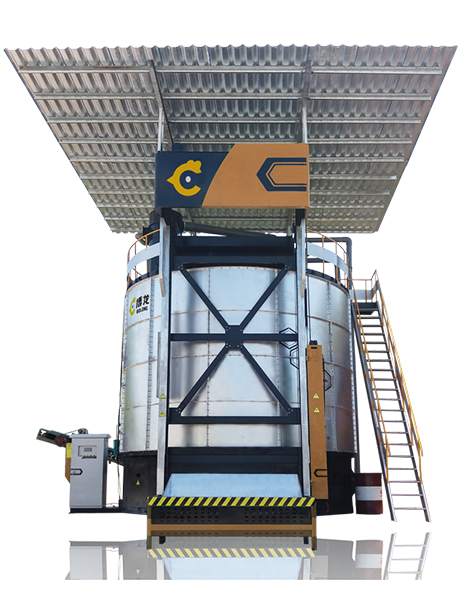
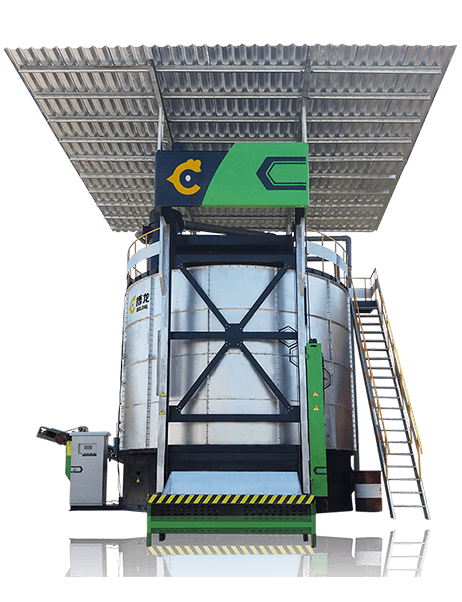
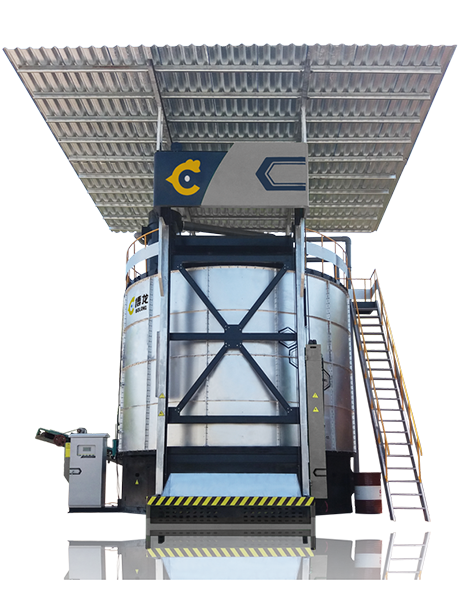
The vessel itself performs the environmental control. The shell is 304 stainless steel with a polyurethane insulation layer, retaining the metabolic heat of the batch rather than relying on external heating, and it is installed outdoors or under a simple shelter rather than inside a building. In configurations fitted with a heat-exchange deodorisation stage, heat recovered from the exhaust preheats incoming air, which reduces the seasonal adjustment required.
Finished compost is used first where its value is easiest to measure: field crops, vegetables and other operations that buy on nutrient content and consistency. In our own test batches the discharged material has been analysed at 52% organic matter and 11.9% total N+P₂O₅+K₂O, negative for fecal coliforms, with no roundworm eggs detected and heavy metals below the limits of the applicable Chinese national standard. Discharge moisture has come back at around 22%, which matters practically: material at that level goes into bags or onto ground without being laid out to dry and loaded a second time.
Figures of this kind should be read as results from our own batches rather than third-party certification, and any supplier presenting them should be asked for the test report behind them. That report is also what a fertilizer registration or a buyer's quality check will eventually require.
Organic matter works on a longer timescale than nutrients do. Its contribution to soil structure — aggregation, water retention, and how the ground carries traffic and holds moisture — accumulates across seasons rather than appearing in one harvest. That makes it the more relevant argument for orchards and pasture, and it is also why consistency between batches matters as much as the analysis of any one batch. Where a local buyer exists the same material is bagged and sold; where one does not, it goes back onto the operator's own land.
The input for an enclosed manure fermentation tank is livestock and poultry manure — cattle, pig, layer or broiler, including mixed material from bedded housing where manure makes up the larger share. Dry materials such as straw, soybean meal and cottonseed meal serve as conditioners: they adjust moisture and supply carbon, and they do not replace manure as the feedstock.
Moisture sets most of the practical work. Above roughly 70% a load needs conditioning before it goes in. The field test is quick: squeeze a handful, and it should hold its shape briefly, break apart when the hand opens and leave no water on the glove.
Sizing follows from daily volume. Eight fixed models span 102 to 280 m³, and both directions carry a cost. A vessel too small leaves manure queuing on the pad, which brings back exactly the handling the machine was bought to remove. A vessel too large is harder to feed a consistent load every batch. Selecting on price rather than on what arrives each day is the mistake that costs the most to correct, because it surfaces after installation rather than before.
Power goes to blowers and hydraulics. Scheduled maintenance covers the hydraulic system, drives, seals and lubrication points, and the turning assembly — diamond-shaped blades set at 30°, driven through a stacked ratchet with hydraulic lift — is arranged so that access determines how long each service visit takes.
None of this disappears after purchase. What the equipment changes is the shape of the work: weekly surprises become scheduled tasks, and a decision carried in one experienced person's head becomes a step in a written routine.
Programmable control is already standard on composting machines of this type. The development under way concerns what gets recorded: batch-level temperature curves, feed ratios and discharge data kept as a matter of course. Where output is sold as a registered fertilizer product, that documentation is moving from useful to expected.
Energy use and emissions move together. Recovering heat from exhaust air returns energy to the intake instead of losing it, and keeping fermentation inside a closed shell with a treated exhaust addresses what open composting cannot: odour and ammonia are generated inside the vessel rather than across a pad, which is what neighbours and inspectors respond to.
The vessel stays the same piece of equipment whatever it is fed. Moving between cattle, pig, layer and broiler manure changes moisture balancing and conditioner ratio; it does not change the machine. That is the practical test of whether an enclosed manure fermentation tank is worth what it costs — not the specification sheet, but whether it produces saleable material every batch, in every season, with the people already on the payroll.
If you are comparing models, ask us for the batch figures quoted here along with a cycle log and the model-matching calculation for your daily volume. We will state in return which of those numbers come from our own test batches and which depend on your site.












 Consultation


